
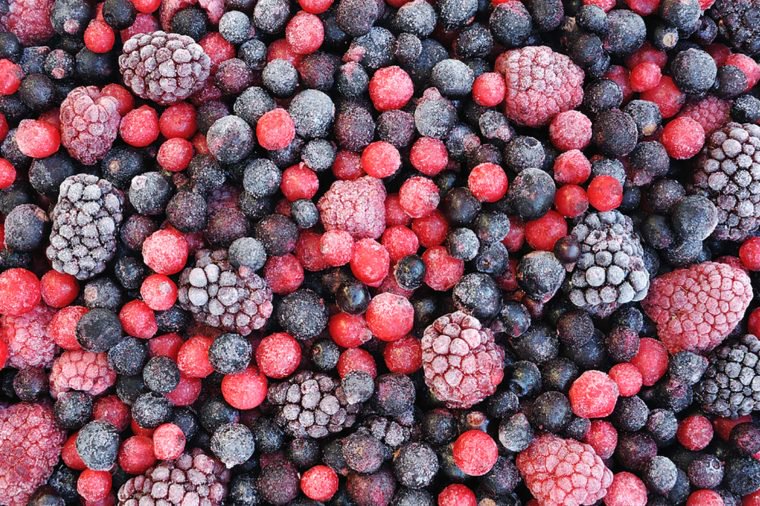
Myth: Frozen fruits and vegetables aren’t as healthy as fresh
Lazy chefs, rejoice: Frozen produce can actually be even healthier than fresh fruits and vegetables. Those fruits are often picked at the peak of their ripeness, then flash-frozen within six to ten hours, says registered dietitian nutritionist Jenna Braddock, MSH, RD, CSSD, LDN, founder of MakeHealthyEasy.com. “That freezing locks in that nutritional value, so it no longer degrades until you use it,” she says. In fact, frozen produce might have even more nutrients than out-of-season fresh veggies. Just make sure to check the ingredients list on a frozen package, because some fruits and veggies will have sugar or salt added.

Myth: Frozen food expires
FoodSafety.gov does list guidelines for how long to keep items in the freezer—for instance, two to six months for leftover cooked meat—but that’s just for quality, not safety. “Frozen food pretty much remains safe indefinitely,” says registered dietitian nutritionist Caroline Passerrello, MS, RDN, LDN, spokesperson for the American Academy of Nutrition and Dietetics.

Myth: Re-freezing food is unsafe
How you’ve handled your food once it’s thawed can tell you if it’s safe to re-freeze. As long as you thawed it safely in the fridge, not on the counter, you should be able to put it back in the freezer safely, says Passerrello. Keeping it cold means it hasn’t been in the “danger zone” between 40°F and 140°F, where bacteria can thrive, for more than two hours. Just beware that it might not taste as good after its second run in the freezer. “You could put it back [in the freezer], but the quality would be frayed,” Passerrello says.

Myth: All frozen food is high in sodium
Many manufacturers are taking a health-conscious cue from consumers and trying to cut the sodium content. Scan the label—you might be pleasantly surprised by how little salt there is. “Unless there is sodium or salt or sodium chloride in the ingredient list, any sodium on the nutrition label is going to be in the food naturally,” says Braddock.

Myth: You can’t freeze milk and eggs
In terms of safety, there’s really nothing you can’t freeze—it just comes down to quality. The texture of some foods, like milk and cheese, might change a bit, but they’re still perfectly safe. In fact, Passerrello recommends freezing single-sized cartons of milk and putting them in your kid’s lunchbox as a disposable (and drinkable) ice pack. Another surprising freezer item? Egg whites. “They hold up better than the yolks,” says Passerrello. So if you need half a dozen yolks for a recipe and aren’t ready to use the whites, just pour them into a freezer-safe container.

Myth: It’s safe to thaw food on the counter
Letting food warm up on the counter is probably the biggest culprit of unsafe thawing, says Passerrello. Leaving food at room temperature for hours on end will put it in the “danger zone,” so bacteria will start to grow.

Myth: Running hot water over food will thaw it safely
Temperature is key when it comes to thawing food in water. Running hot water over frozen food (in a leak-proof packaging, of course) could cause safety issues. “Parts of your item can be frozen while other parts are hot and might even be starting to cook, leading to uneven cooking,” says Braddock. The USDA recommends using cold water and changing the water every half hour.

Myth: Packaged food can go straight in the freezer
Just because those chicken breasts are already wrapped up doesn’t mean they’re freezer-ready. Meat wrappers let in airflow, creating an entryway for bacteria to get in, and making the quality deteriorate in the freezer, says Passerrello. Rewrap the food, pushing as much air as you can out, before freezing it. As for vegetables, blanch them before freezing, she recommends. The boiling water will change an enzyme reaction to stop the food from breaking down and getting soggy in the freezer, says Passerrello.

Myth: Frozen meals are always a balanced option
Frozen foods can be a good base for a meal, but that doesn’t necessarily mean they’re a well-rounded option. For instance, a frozen breakfast might be better with a piece of fruit and protein-packed yogurt on the side, or you should add a side of veggies to a kid’s meal. “It’s just trying to add a little more to make sure you or your child is getting a more balanced array of nutrients,” says Braddock.

Myth: Frozen meals are always a balanced option
Grocery stores use “sell by” dates to make sure they’re rotating their inventory, and a “use by” date just indicates a product’s peak quality—not a safety measure, according to the USDA. Popping food in the freezer on those dates shouldn’t have any health consequences, says Braddock.